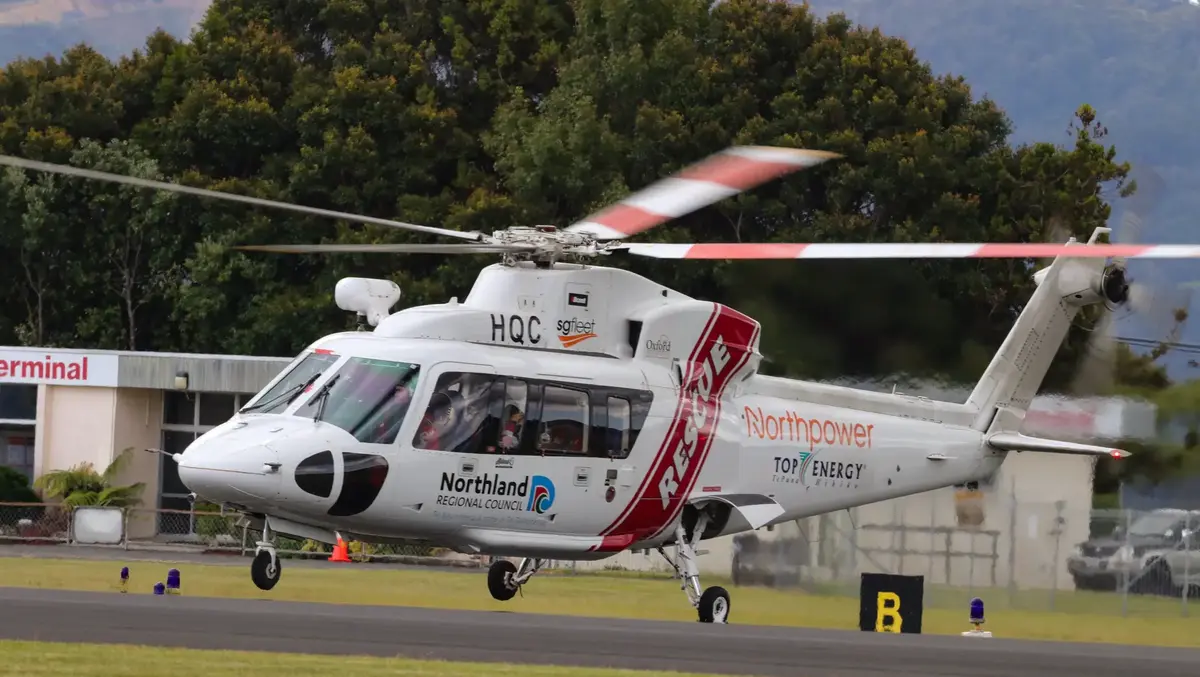
Intensive care specialist questions Whangārei airport rescue helicopter location
Wed, 16th Sep 2026 (Today)
An intensive care specialist involved in helicopter patient transfers has questioned the benefits of Northland's rescue helicopter base at Whangārei Airport.
The criticism comes as Northern Rescue Helicopter (NRHL) makes its first formal bid to secure a permanent future in Onerahi, despite ongoing noise complaints from neighbours.
Whangārei Hospital intensive care consultant Dr Stefan Wiese, who is an airport neighbour, said basing helicopters at the airport did not improve the type of mission most sensitive to location: secondary patient transfers between hospitals.
Writing to Whangārei District Council Mayor Ken Couper in a letter tabled at the council's August airport noise committee meeting, Wiese stressed he supported the regional rescue helicopter service as a "genuinely lifesaving asset" for Northland.
However, Wiese said the airport base did not deliver meaningful advantages for secondary transfers, instead believing it created inefficiencies through additional road journeys, ambulance transfers and delays due to Onerahi's frequent fog.
"In short, Onerahi does not improve the one function most sensitive to base location, while imposing significant ongoing impacts on a residential community.
"I ask (the council) to weigh this operational reality alongside residents' legitimate concerns and work with the company toward identifying a permanent site that serves both patient outcomes and community wellbeing."
Wiese said the airport had changed significantly since emergency helicopter operations moved to Onerahi in July 2025.
"It is now effectively a 24-hour aviation hub, with helicopter movements at all hours disrupting sleep and daily life for those living around the airport."
In response, NRHL's chief executive Ian MacPherson said the company respected Wiese's views and recognised the importance of timely inter-hospital transfers, but that the Whangārei base needed to be considered in the context of all services provided.
MacPherson said the airport base had the infrastructure needed for a safe, reliable and efficient 24/7 operation.
Wiese's letter was among airport neighbours' correspondence to Mayor Couper, including from community lobby group ECHO (Environment Community Health Onerahi), tabled at the August 26 airport noise committee meeting.
NRHL is seeking the "longest lease term" that the council is prepared to grant.
MacPherson said this would enable the long-term consolidation of its flight, engineering and support functions at Whangārei Airport.
NRHL has run a split-base operation since moving its emergency helicopter flights from its Kensington site to Onerahi in 2025.
The company's current 10-year airport lease runs until 2034.
Kensington remains its base for fleet maintenance, heavy engineering and engine testing, the latter subject to noise controls. The lease there has just been extended until potentially 2029.
Couper confirmed the council had received communication from NRHL regarding its future airport lease, but it had not yet been considered by councillors.
Whangārei District Council (WDC) has spent more than a decade investigating an alternative future airport site amid concerns about the long-term viability of the existing airport.
Residents oppose permanent airport base
Onerahi resident Natalie Hinke said the airport was never intended to operate as a 24-hour industrial aviation hub within an established residential area.
The correspondents' concerns come amid ongoing debate over aircraft noise around the airport.
Since emergency flights moved to Onerahi, residents have lodged more than 240 noise complaints relating to 344 noise incidents. More than 60% of these relate to incidents between 10pm and 7am.
Onerahi's Gary Stables, an ECHO committee member and community representative on WDC's airport noise committee, said the lobby group opposed a permanent helicopter base at the airport.
Stables said the airport was already operating close to its permitted noise limits. Shifting NRHL's remaining activities to Onerahi would increase the risk of those limits being breached, he said.
Onerahi residents fully supported the rescue helicopter service.
"Our concern is solely about where those operations are based, not about the essential work the rescue helicopter performs."
According to a report by WDC property manager John Burt, the letter writers supported the rescue helicopter service but questioned whether the airport was the appropriate permanent location because of its proximity to the residential community.
Burt said discussions around NRHL's new request were at an early stage, and no decision had been made.
Mayor says rescue helicopter provides life-saving service
Couper acknowledged Wiese's comments, but reiterated the council's role in considering any application.
"Council's role is to ensure appropriate airport infrastructure and governance arrangements are in place and to consider matters within its statutory responsibilities."
He said airport noise could be challenging for some residents, but the rescue helicopter service provided an essential and often lifesaving service for Northland communities.
The council would consider operational requirements, community feedback, legal obligations and the wider public interest before making any decisions, he said.
NRHL backs airport location
NRHL chief executive Ian MacPherson said the airport remained NRHL's preferred long-term base, because of its infrastructure.
Alternate sites would introduce operational constraints, including reduced weather capability, fuel limitations and additional helicopter movements that did not directly involve patient transport or rescue missions.
Multiple locations had been investigated before deciding the airport at Onerahi was the most suitable.
The Environment Court had also identified it as the most appropriate location.
"The current split-site arrangement is an interim solution and is not considered sustainable or operationally efficient in the long term."
Responding to ECHO's noise concerns, MacPherson said co-locating all operations at the airport would reduce aircraft movements between Onerahi and Kensington.
"With our operational, engineering and support functions co-located, there will be less need for aircraft to travel between the two sites for engineering and operational purposes, meaning fewer non-operational flights."