

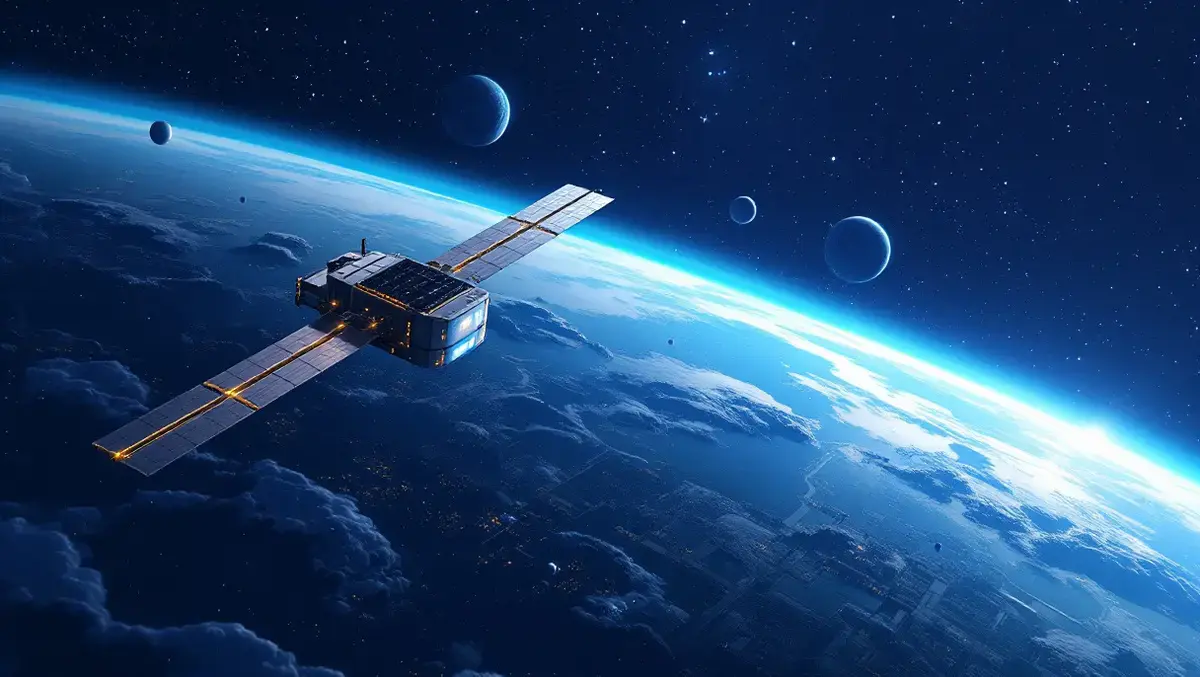
SAP to test AI model on International Space Station
Wed, 28th Oct 2026 (Today)
SAP plans to deploy its SAP-RPT tabular AI foundation model on HPE Spaceborne Computer-2 aboard the International Space Station, testing how an enterprise AI model performs in an extreme edge-computing environment.
The deployment is planned for early 2027 and will use structured data from onboard sensors and mission telemetry to assess system health in orbit. The model is intended to run directly on the station rather than relying on analysis sent back to Earth, where delays can reduce the value of time-sensitive operational data.
SAP-RPT is designed to make predictions from tabular data even when some information is missing, without the model training or fine-tuning often associated with other AI systems. On the station, it is expected to support anomaly triage in telemetry, predict emerging faults, reconstruct missing sensor readings from historical data, and produce mission-health reports for astronauts and ground teams.
The project connects a space-based use case with SAP's broader push to apply AI to business operations built around structured datasets. SAP argued that the same type of early-warning analysis used to detect technical problems in orbit can also be applied on the ground to identify issues such as supplier disruption, unusual cash-flow patterns, and equipment faults before they worsen.
Structured data
SAP-RPT is part of SAP's broader portfolio of tabular foundation models, alongside the TabPFN model from Prior Labs and SAP AI Core, which is used to manage prediction workflows and governance. SAP positioned tabular models as a complement to large language models, saying they are built for the structured operational data that underpins industrial systems, finance, and supply chains.
Energy use is a key factor in the station deployment. SAP said SAP-RPT is about 50,000 times more energy-efficient than state-of-the-art large language models, linking that claim to the strict power constraints of orbital computing.
SAP also said the model can adapt as operating conditions change without requiring pre-training. Expected onboard outputs include real-time health predictions for the computer and wider mission systems, a mission risk score, an indication of whether manual intervention is needed, human-readable explanations of findings, and ad hoc reports for crew and ground teams.
Mayank Shrivastava, Vice President of Generative AI and Foundation Models at SAP, described the project as a technical and commercial test case for the company's work in AI for structured data.
"This is proof that tabular AI on SAP works at the edge of possibility," said Mayank Shrivastava, Vice President of Generative AI and Foundation Models at SAP. "Space is the ultimate stress test for AI. If a foundation model can predict mission-critical failures in orbit, under radiation, energy, and connectivity constraints, imagine what it can do for a global enterprise. This is the same model that will predict supplier risk, cash flow anomalies, and equipment failures across your enterprise. What works in orbit works in your supply chain."
Space test
HPE's Spaceborne Computer-2 provides the onboard computing platform for the deployment. The system has been used on the International Space Station to test how advanced computing workloads perform in space, where radiation, intermittent links, and limited maintenance access create operating conditions very different from those in terrestrial data centres.
SAP said those constraints closely parallel difficult operating environments on Earth, including disaster relief, remote agriculture, distributed manufacturing, and dispersed supply chains. In such settings, local processing can matter because connectivity is patchy and decisions often need to be made close to where the data is generated.
Scott Wiest, Vice President and Global Sales Chief Technologist and HPE Fellow, said the deployment adds another AI workload to the orbital computing platform.
"HPE Spaceborne Computer-2 continually demonstrates the advantages of having a high-performance compute solution aboard the ISS, supporting advanced technologies and ongoing research in space," said Scott Wiest, Vice President and Global Sales Chief Technologist and HPE Fellow at HPE. "Deploying SAP's tabular AI on HPE Spaceborne Computer-2 shows what's possible with real-time detection and prediction using AI in the ultimate edge environment."
The project also reflects a broader industry effort to move more AI inference closer to the source of data rather than sending all information back to central infrastructure. For enterprise software suppliers, that shift opens up applications in factories, logistics networks, and field operations where latency, bandwidth, and resilience affect business performance.
SAP said the work on the station will inform its enterprise edge AI roadmap, particularly for analytical and operational processes that rely on structured data in constrained settings. It linked the orbital deployment to longer-term ambitions around space-based compute infrastructure and deep-space missions, with the station serving as an early test bed for how such systems might function under strict limits on power, connectivity, and failure tolerance.